 (Photo: Kristian Dugstad/TONO)
TONO has recently submitted two submissions to Norwegian authorities on artificial intelligence and copyright. “Our main message is that music creators must have control over their works, be paid when their music contributes to value creation, and be able to enforce their rights in the face of artificial intelligence,” says Inger Elise Mey at TONO.
/ 14/10/2026 / Willy MartinsenThe Storting will consider Prop.41 LS on the implementation of parts of the EU's Digital Markets Directive into Norwegian law. At the same time, the SV has submitted a representative proposal for stronger protection of copyright in the face of artificial intelligence.
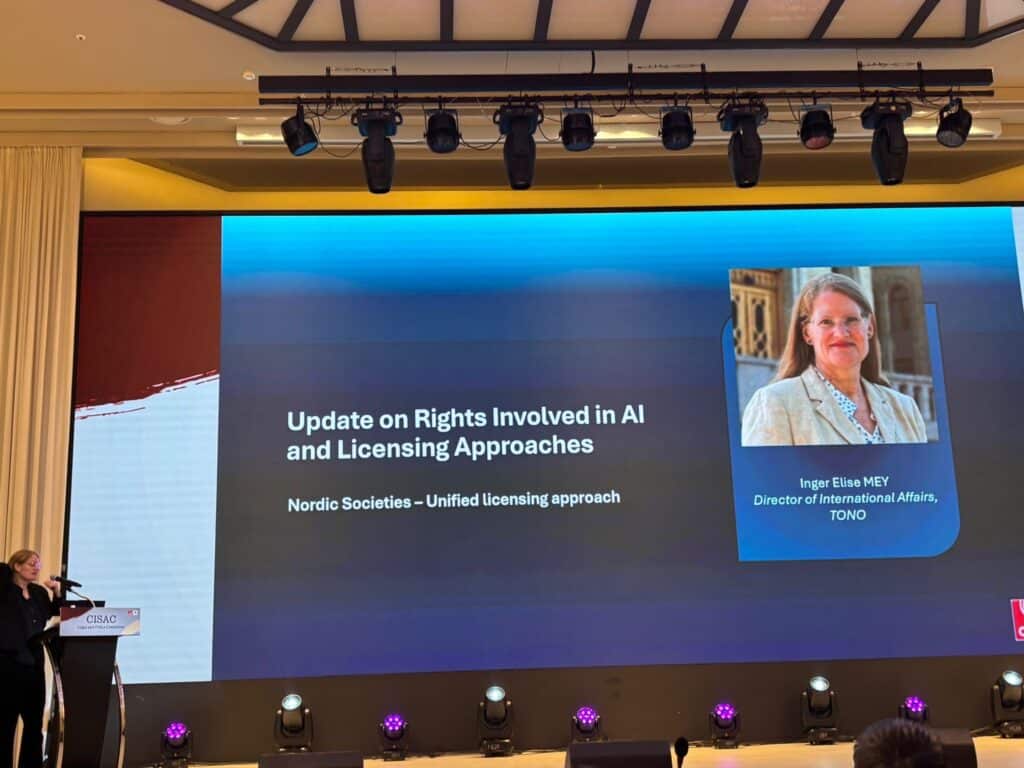
TONO has submitted input to both of these, penned by TONO's Director of International Affairs, Inger Elise Mey.
– Artificial intelligence services are now being developed at the expense of artists, not as a healthy partnership for the benefit of both parties. This must end. There must be clear rules that state unequivocally that technology companies must respect copyright. They must ask for permission, artists must have a real right to say no, and AI companies must pay for themselves, states Inger Elise Mey.
The development of generative artificial intelligence means that society is in the midst of a technological revolution.
– This is happening now. The rules that are being established now, good or bad, will have enormous consequences for how society will relate to the new technology for a long time to come. It is therefore absolutely crucial that both European and Norwegian authorities establish rules that create a real balance between technology companies and artists, says Mey.
One of TONO's main points in both submissions is that AI companies must begin to provide information about which works they have relied on in training their AI models.
– We do not have access to this as of today. This makes it impossible for copyright holders to know whether their music has been used or not. This also makes it practically impossible for TONO to know whether KI companies need a TONO license. KI companies must be forced to show their cards. Transparency is a fundamental prerequisite for copyright to work in practice.
Therefore, TONO demands that the authorities investigate solutions that give TONO, on behalf of its members, the opportunity to identify which works have been used in AI training.
TONO also argues that all use of music for AI training should be based on consent, in practice collective licensing through TONO, the Norwegian music creators' self-owned management company.
– Collective licensing ensures fair remuneration for both the most successful and the less successful songwriters, composers and lyricists. We are positive about technological development, but it must take place within the framework of copyright and established arrangements, she says.
TONO points to the proposed rules on text and data mining in its contribution to Bill 41 LS.
– It is unclear whether the provisions are suitable for generative AI. We warn against solutions that make it impossible for rights holders to reserve their music against AI training. We need protection that is possible to exercise and there must be solutions that actually work, says Mey.